
Practical Garden Guide
Compost Tumbler vs Compost Bin: Which Fits Your Yard?
The better system is the one that fits your material volume, batch routine, turning method and plan for harvesting finished compost.
By Gardening Is Ezee EditorsUpdated 16 min read
Choose a compost tumbler when a compact, enclosed system and rotating access suit the materials you produce. Choose a compost bin when you need more capacity, want to handle seasonal yard waste, or prefer a simpler stationary structure. Neither design guarantees fast compost. The material mix, moisture, air, batch management, and time still determine how the process goes.
A tumbler and a bin also create different routines. A tumbler asks you to load through an opening, rotate a container, and eventually empty it. A bin asks you to manage a pile, mix or move material where needed, and harvest through an opening or by dismantling part of the structure. Decide which routine you will actually maintain.
The right purchase is not the most elaborate container. It is the system that fits your waste stream, physical access, garden space, and expectations for finished compost.
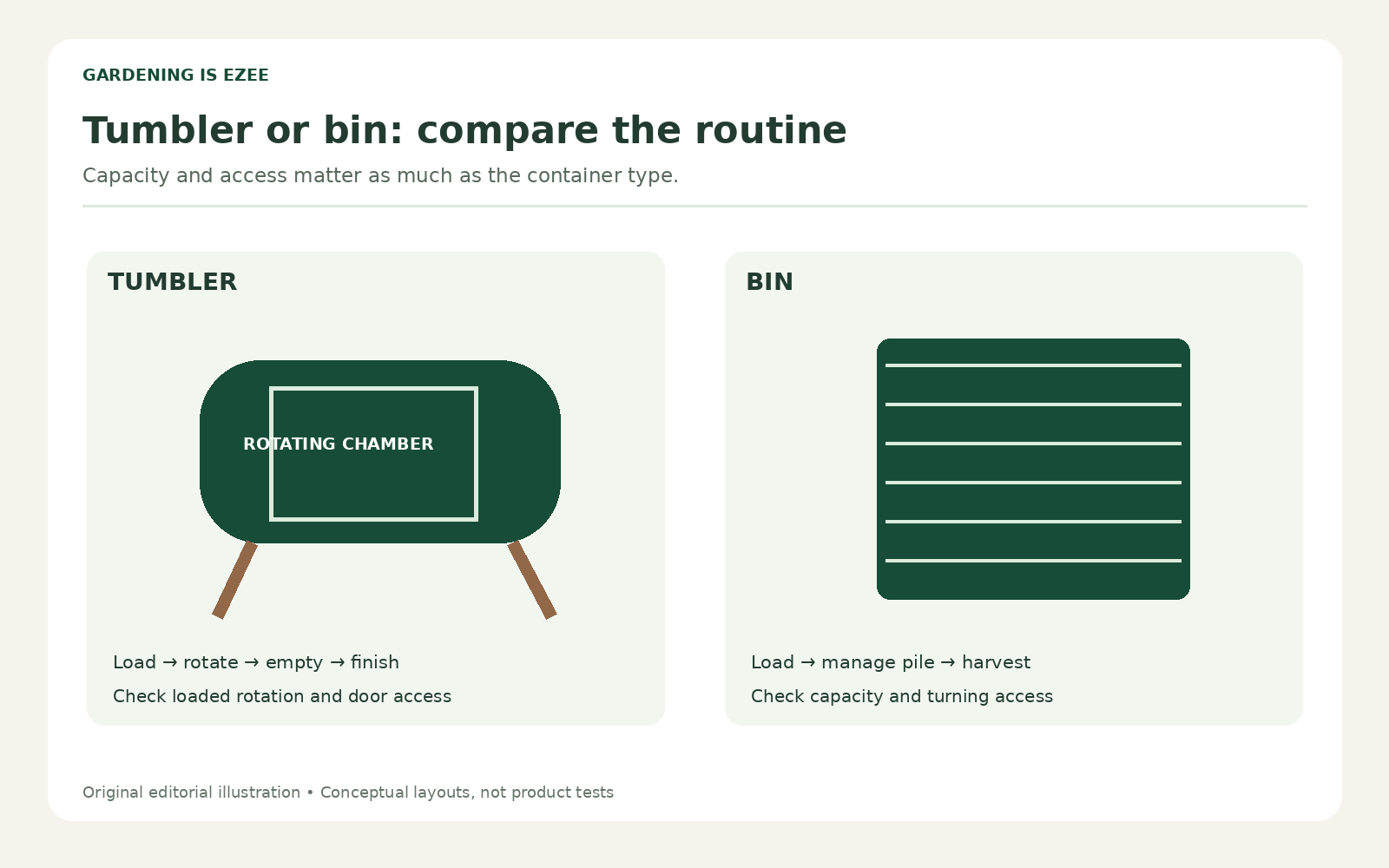
Illustration: Gardening Is Ezee. Capacity, enclosure, and access vary by product.
Begin with what you need to compost
For one week, estimate the amount of appropriate kitchen scraps and garden material you generate. Then think about seasonal peaks: autumn leaves, spring pruning, vegetable-bed cleanup, or occasional grass clippings. A system that handles the weekly kitchen bucket may be too small for a whole yard's seasonal waste.
Separate compostable inputs from items your system should not receive. Meat, greasy leftovers, pet waste, treated wood, and materials intended only for commercial composting are not ordinary additions to a basic backyard system. Use a current accepted-materials reference rather than assuming anything organic belongs in the container.
The EPA's home composting guide provides a practical input reference. Before buying a product, write down what you will put into it and where unsuitable materials will go. A clear collection routine helps more than adding capacity for material you should not compost at home.
How a tumbler changes the work
A tumbler holds material in a rotating chamber. The design lets you mix by rotating the container rather than turning the whole batch with a fork. That can be convenient, but the effort depends on chamber size, load, balance, handle design, and the user's abilities.
Try the loading height and opening size if you can inspect the product in person. Would your kitchen bucket fit comfortably? Can you add dry leaves without spilling them? Can you remove finished material into a tray or cart? A small opening can turn a simple daily task into an awkward one.
Do not judge ease of rotation from an empty display model alone. A wet load behaves differently. Read operating limits and user instructions, and consider how you would manage the unit at its normal working fill rather than at the maximum advertised capacity.
How a stationary bin changes the work

Multiple compost bins can separate fresh material from batches that are finishing. Photo: Michal Klajban, CC BY-SA 4.0 via Wikimedia Commons.

A bin contains material in one location. It may be a simple wire enclosure, a wooden structure, or a manufactured plastic unit. Some designs allow a front panel to open; others rely on a small lower hatch. Access varies enough that bin should not be treated as one uniform product type.
A larger accessible bin can suit substantial leaf and garden waste. If you want to turn the contents, make sure the structure leaves room for the method you intend to use. A narrow top opening may be inconvenient for a fork, even when the total volume sounds generous.
A passive system can involve less routine mixing but require more patience and space. That can be a good match for someone whose priority is waste reduction rather than a rapid batch. Choose the method deliberately instead of purchasing a bin advertised for quick results and then managing it as a slow pile.
Compare capacity honestly
A tumbler's advertised total volume may include two separate chambers. Each chamber has less space than the overall number suggests, and the usable working fill may be lower still. Check dimensions and instructions before comparing it with a single large bin.
Capacity should include space for appropriate dry materials, not only the food scraps you want to get rid of. A kitchen-scrap-heavy stream can become difficult to manage when there is no room for the companion materials. Buying a tumbler that fits only the wet inputs can create predictable problems.
For a bin, consider access as well as size. If you cannot reach or move the lower material, a large advertised volume may not be practically useful. A modest two-bin setup can sometimes be easier to operate than one large inaccessible container.
Batch composting versus continual additions
A batch has a clear starting point and eventually stops receiving fresh material. That makes it easier to distinguish material still decomposing from material being prepared for use. Continual additions mix stages unless the system has a deliberate harvest method.
A single-chamber tumbler can work as a batch system if you have somewhere else to put new scraps while it finishes. Without that second destination, you may keep adding material indefinitely and never know when the whole chamber is ready.
Two chambers or two bins can separate active loading from finishing, but only if you use them that way. The extra chamber is not an automatic solution. Label it and stop adding fresh inputs when it becomes the finishing batch.
Heat is a process outcome, not a product feature
A dark container in sunshine can become warm from the weather. That is different from heat generated within an active compost batch. Do not judge composting performance solely by touching the outside shell on a sunny afternoon.
Some small home systems do not sustain a substantial hot phase. That does not automatically mean they cannot produce compost; it means the method and expectations need to match the system. University of Maryland Extension's compost method comparison notes the limited volume of many tumblers as a constraint for hot composting.
Do not assume a warm tumbler sanitizes every input or destroys all weed seeds. Reliable time-and-temperature treatment requires more than an occasional warm reading. Choose appropriate inputs for an ordinary home system and use a managed process if sanitization is an actual requirement.
Odor depends on management
An enclosed container can still smell if the materials are unsuitable or the mixture becomes wet and poorly aerated. A bin can also smell, particularly when fresh scraps remain exposed or the pile is poorly managed. Neither product category is odor-proof.
Inspect the mixture rather than covering the smell with additives. Look at the moisture, structure, and recent inputs. Keep suitable dry materials near the composter so you can manage the batch when you add wet scraps. An attractive container placed far from those supplies makes the routine harder.
If odor is already a problem, pause new additions while you diagnose it. Review the material list and improve the mixture through a reliable composting method. Buying another container without changing the input routine can carry the same problem into the new system.
Pests and enclosure
A secure enclosure can help reduce access, but pest resistance varies by product and installation. Check openings, doors, base construction, and gaps. Raised does not necessarily mean pest-proof, and a lid does not help if it is left open after loading.
Input selection and housekeeping remain important. Avoid leaving scraps around the base or storing an open kitchen bucket beside the unit. Keep the loading area clean and use the system's approved method for incorporating fresh material.
If your location has persistent animal pressure, investigate the complete installation rather than relying on a broad pest-resistant claim. A bin may need a suitable base barrier or another design; a tumbler may need better closure or placement. Follow current local and product guidance.
Placement: access beats an idealized corner
Place the system where you can reach it during the weather in which you will use it. A remote corner may hide it neatly but discourage winter trips with a kitchen bucket. Check the path, surface, drainage, and room for harvesting.
A tumbler needs stable support and rotation clearance. A bin needs room to open, turn, or remove material. Leave space for the tray, bucket, cart, or fork that belongs to your routine. Evaluate the full task, not just whether the container's footprint fits.
Avoid placing the system where leaks, spills, or runoff create a nuisance. Think about nearby doors, shared boundaries, and access routes. Good placement makes regular inspection easy and helps you notice a small problem before it becomes persistent.
Browns storage is part of the system
A composter is only one part of the workflow. You also need a supply of suitable dry material and a way to collect appropriate wet scraps. If dry leaves are available only in autumn, plan storage for the months when the kitchen stream continues.
Keep the storage convenient and protected in a way that suits the material. A labeled container of shredded leaves near the loading point can make balancing additions much easier. It also shows when your supply is running low before the next wet batch arrives.
Do not choose a tiny footprint by ignoring the support area. A compact tumbler plus a dry-material container, collection bucket, and curing space may occupy more room than the product photograph suggests. Compare complete workflows fairly.
Harvesting can decide the purchase
A tumbler may require rotating an opening downward, scooping material out, or using another model-specific method. Check whether a tray fits underneath and whether the opening aligns where you need it. Read the instructions rather than assuming the design empties cleanly.
A bin may offer a lower hatch, removable side, or full access from above. A lower hatch can be convenient, but continual additions mean you still need to distinguish finished material from fresher inputs. Assess whether the harvest method fits your composting approach.
Imagine harvesting after rain, with a loaded container and limited space. Can you reach the material without excessive lifting or bending? Does the cart fit? These practical details are often more important than a small difference in advertised capacity.
Curing needs a destination
Material can need a finishing period after active decomposition. Plan a protected, suitable place for that stage rather than assuming everything coming out of a tumbler is immediately ready for seedlings. Stop adding fresh scraps to material you intend to finish.
A separate curing container or bin can keep the loading system available. Label batches so you do not mix fresh and finishing material accidentally. The method should remain understandable to everyone in the household who empties the kitchen bucket.
Evaluate readiness from the material's condition and the chosen composting method, not a fixed marketing timeline. For nutrient-sensitive uses or questionable inputs, obtain appropriate guidance or testing. Homemade compost quality is not established by the brand of container that produced it.
Costs beyond the purchase price
Include delivery, assembly tools, a collection bucket, dry-material storage, a harvesting tray, and any thermometer or screening equipment you actually need. Those are workflow costs, not reasons to buy every accessory offered beside the product.
Compare repairability. Can a hinge, handle, door, or panel be replaced? Is the stand durable and appropriate for the location? A low purchase price may be less attractive if a small broken part makes the whole unit unusable.
Avoid calculating savings from an unrealistic promised output. Compost yield varies with inputs and process. A system can still be worthwhile for waste reduction and gardening convenience without producing a precise amount of retail-equivalent compost every month.
Three household examples
Small household, little yard waste
You generate a modest amount of vegetable scraps and have limited outdoor space. A compact tumbler may fit if you can also store dry materials and allow a batch to finish. Check actual chamber capacity and access before ordering.
If inputs arrive slowly, do not expect a fast hot batch simply because the container rotates. A slower method or another home composting approach may fit better. Match expectations to the amount of material you can collect.
Large garden with autumn leaves
A larger bin or multi-bin arrangement may be more practical for seasonal volume. A small tumbler can become a bottleneck if you try to process bags of leaves through a narrow opening. Think about storage and staged processing.
You might use one method for kitchen scraps and another for leaves. There is no need to force every material through a single product. Separate workflows can be simpler when the input types and volumes differ greatly.
Gardener who wants less fork-turning
A tumbler may reduce the need to turn a pile manually, but test the loading, rotation, and emptying demands. If a full chamber is difficult to rotate, the design has not necessarily reduced overall effort.
An accessible bin managed more slowly can also be an option. Decide which actions are comfortable and which ones are difficult. The best physical fit is personal and depends on the working position, not just the label easy-turn.
A product comparison checklist
| Question | Tumbler | Bin |
|---|---|---|
| What is the usable working capacity? | Check each chamber separately | Check accessible pile volume |
| How will you mix? | Evaluate loaded rotation | Evaluate turning access or passive method |
| Where do new scraps go during finishing? | Second chamber or separate destination | Separate bin or deliberate harvest method |
| How will you empty it? | Check door and tray clearance | Check hatch or removable panels |
| What supports the input routine? | Browns storage and collection bucket | Browns storage and collection bucket |
| What can be repaired? | Handles, doors, stand, bearings if applicable | Panels, lids, hinges, base |
Use Gardening Is Ezee's compost tumbler comparisons and FCMP tumbler guide after you have answered these questions. A brand shortlist becomes more useful when you know the routine and capacity you need.
Frequently asked questions
Is a tumbler always faster?
No. Speed depends on the material mix, moisture, air, batch size, temperature, and management. Rotation can help mixing, but it does not turn unsuitable inputs into a balanced batch or make a small load behave like a large managed pile.
Is a bin cheaper?
A simple homemade enclosure may cost less than a manufactured tumbler, but compare the complete installation and your needs. Tools, base materials, replacement parts, and access all matter. A cheaper structure is only useful if you can operate it effectively.
Do I need two chambers?
Two chambers can separate loading from finishing. They are useful only if the household follows that routine. One large chamber plus a separate curing destination can also work. Compare each chamber's usable volume, not only the combined advertised total.
Can I compost all kitchen waste?
No. Use an accepted-material list suited to ordinary backyard composting. Commercially compostable packaging, greasy foods, and other difficult materials may require a different destination. A sealed-looking container does not automatically make those inputs appropriate.
What if the tumbler never gets hot?
Check volume, materials, moisture, and measurement before assuming failure. Some small systems work through a slower process. Read Why Is My Compost Tumbler Not Heating Up? for a structured diagnosis.
Audit a product listing before adding it to your shortlist
Begin with the usable capacity and the actual dimensions. A photograph can make a compact tumbler look substantial when there is no scale reference. Check chamber volume, door size, rotation clearance, and the height at which you will load it. For a bin, check the access opening and how the sides or panels move during harvest.
Look for a clear operating manual. It should explain assembly, working fill, acceptable use, rotation or access, and maintenance. A product that is simple in appearance can still have important limitations. If the listing promises rapid compost but provides no usable process instructions, treat the timeline cautiously.
Inspect the stand or base design. A tumbler needs stable support under a working load; a bin needs an appropriate location and whatever base arrangement the method requires. Consider weather exposure and replacement parts. The container should fit the place where it will operate, not just the space where it can be photographed neatly.
Review whether the design suits your physical routine. Can you reach the door from a comfortable position? Can you scoop material without lifting a heavy bucket above shoulder level? Can you move a cart to the harvest opening? These questions turn ergonomic claims into practical decisions you can assess.
Ask how failed small parts are handled. A broken latch, handle, or panel should not be a mystery. Check whether parts are available and whether the warranty covers the intended installation. Keep the manual and purchase information so a later repair does not require rediscovering the product.
Plan the whole household routine
A compost system works better when everyone uses the same collection rules. Put a short accepted-material list near the kitchen container. Make the destination for unsuitable waste obvious. This avoids one person carefully following the method while another adds greasy leftovers or packaging because it says compostable.
Choose a collection container that is easy to empty and clean. It does not need to be an elaborate accessory. The important features are a practical size, suitable closure, and a routine that prevents the contents from sitting neglected. Locate it where it helps food preparation without becoming an obstacle.
At the outdoor system, keep dry material available and instructions brief. Label a finishing chamber or bin clearly. If you want new scraps added only to one section, make that visible. A two-chamber product loses its main workflow benefit when household members add fresh material to whichever door is easiest to open.
Assign a simple inspection routine. One person can check moisture, odor, access, and capacity at a regular interval. The check should identify whether the process needs adjustment, not require constant measurement. If the household generates more material than the system can handle, arrange another appropriate destination rather than overloading it.
Review the system after a month of ordinary use. Did the capacity fit? Was loading convenient? Were dry materials easy to find? Could you keep finishing material separate? Those observations are more useful than judging the purchase solely by how much compost appeared immediately.
If the routine is failing, change the simplest part first. Move the dry-material storage, improve the labels, choose a more convenient path, or adjust collection frequency. A different composter may eventually be justified, but workflow problems should not automatically trigger another product purchase.
Know when neither option is the best starting point
A household without suitable outdoor access may need a different method or a local collection service. A garden producing mostly leaves may benefit from a dedicated leaf-management approach. Someone who cannot safely rotate a loaded chamber or turn a pile should evaluate accessible alternatives rather than forcing a standard system to fit.
The choice is not limited to tumbler or bin at any cost. Start with the materials and actions you can manage, then select a method. That approach makes the eventual product purchase smaller, clearer, and more likely to remain useful through ordinary seasonal changes.
Make an honest comparison of space requirements
Draw the composter footprint, then add the space required for ordinary operation. A tumbler needs rotation clearance and a loading position. A bin needs opening and harvesting access. Both may need dry-material storage, a collection container, and a destination for finishing material.
Test the route with the objects you will use. Carry an empty bucket to the proposed location and imagine unloading it in rain or cold weather. Check whether a cart can reach the harvesting point. The product fitting into a corner does not establish that the workflow fits there.
Keep enough room to inspect and clean around the base. A tightly packed installation can hide spills, leaks, or animal activity. It can also make small repairs awkward. Practical access is part of the purchase, not an optional improvement to consider after assembly.
If two systems require similar total space, compare the actions rather than the footprints. Which loading height is comfortable? Which harvest method is manageable? Which one leaves a clear route year-round? The answers make the decision specific to your household instead of relying on a general claim that one container type is compact.
Sources and further reading
- US EPA: Composting at Home.
- US EPA: Approaches to Composting.
- University of Maryland Extension: How to Make Compost at Home.
- Oregon State University Extension: Choosing and Using a Composting System.
- Oregon State University Extension: Compost Tumbler Suggestions.
Editorial method: This comparison combines cited process information with original purchasing and workflow advice. The household examples are hypothetical. No product testing or guaranteed compost timeline is claimed.